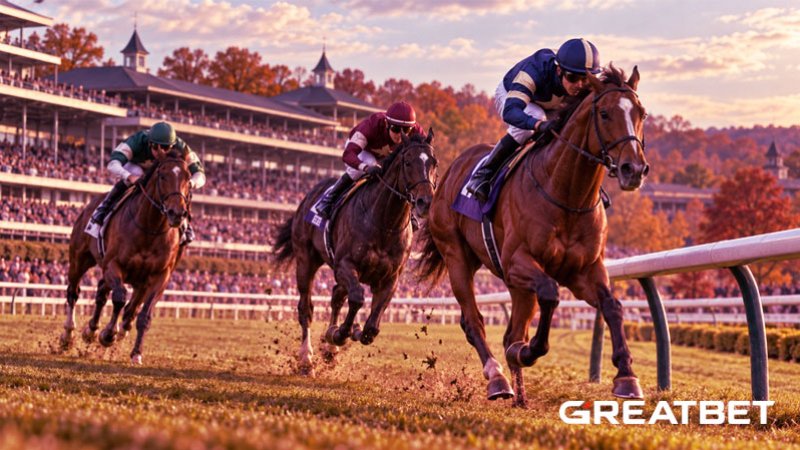
The Breeders' Cup is one of the defining meetings in international horse racing. Staged in the United States each autumn, it brings together leading thoroughbreds from North America, Europe, Japan and beyond for two days of championship action on dirt and turf.
For British racing followers, the meeting offers a distinctive test. Familiar European turf stars face different track layouts, sharper turns and a demanding style of racing, while the leading American runners compete on home territory. That contrast has helped the Breeders' Cup develop into a genuine global championship.
How the Breeders' Cup began
The idea for the Breeders' Cup was announced in 1982 by Kentucky breeder John R. Gaines. His plan was to create a series of valuable championship races that would bring the best horses together at the end of the season.
The inaugural meeting took place at Hollywood Park in California on 10 November 1984. It featured seven races and established many of the principles that still define the event: elite competition, major prize money and championship races for different ages, distances and surfaces.
Chief's Crown won the first Breeders' Cup race, the Juvenile, while Wild Again produced a famous victory in the first Classic. The meeting quickly became an important target for leading owners, trainers and breeders, and its programme expanded as its international reputation grew.
A travelling championship
Unlike many major racing festivals, the Breeders' Cup does not have one permanent home. It moves between leading North American racecourses, giving the championship a different character depending on the host venue.
Hollywood Park staged the first edition, while Santa Anita, Churchill Downs, Belmont Park, Keeneland, Del Mar and several other tracks have since hosted the meeting. Woodbine in Canada became the first venue outside the United States to stage it in 1996.
The changing venue adds another layer to the challenge. Track configuration, surface, climate and local conditions can all influence how races unfold. Some courses have tight turns and short finishing straights, while others place greater emphasis on stamina or tactical positioning.
How the two-day meeting works
The modern Breeders' Cup is held across two days. Friday is commonly known as Future Stars Friday because its championship races are reserved for two-year-olds. Saturday brings together the main races for older horses, alongside several contests that remain open to three-year-olds.
The programme covers a broad range of divisions. There are sprint races, mile contests and middle-distance events, with championships on both dirt and turf. Separate races for juveniles, fillies and mares ensure that the meeting tests quality across the thoroughbred racing spectrum.
The Breeders' Cup Classic is the headline dirt race, while the Breeders' Cup Turf is a major international target over a mile and a half. The Mile, Sprint, Distaff and Filly & Mare Turf are also firmly established among the sport's most valuable and competitive championship contests.
Why turf races matter to European challengers
The Breeders' Cup has long attracted horses from Britain, Ireland and France, particularly for its turf races. European runners often arrive with strong form from prestigious meetings and races such as the Prix de l'Arc de Triomphe, but they must adapt quickly to the different demands of American racing.
Many Breeders' Cup turf races are run around relatively sharp bends and at an even tempo. A wide draw can force a horse to cover extra ground, while a slow start may leave too much to do in a short home straight. Jockeys therefore need to balance patience with the need to secure a useful position.
Those tactical questions make the international clashes especially compelling. European horses may bring proven stamina and high-level turf form, while American runners often possess valuable course experience and early speed.
The importance of dirt racing
Dirt racing gives the Breeders' Cup much of its unmistakable American identity. The surface can produce fast, strongly contested races in which early position matters. Horses must handle kickback, maintain rhythm and conserve enough energy for the closing stages.
The Classic sits at the top of the dirt programme and has been won by many of the most celebrated American racehorses. The Distaff provides a championship target for fillies and mares, while the Sprint and Dirt Mile reward a different balance of speed, power and tactical sharpness.
For followers more familiar with British turf racing, these contests offer a useful introduction to the structure and strategy of top-level American racing.
Qualification and the road to the meeting
Places at the Breeders' Cup can be secured through the Challenge Series, widely known as Win and You're In. Selected races around the world offer their winners an automatic qualifying position in a corresponding championship race, subject to the programme's conditions.
The series gives the meeting a genuinely international pathway. Qualifying races are staged in major racing nations across several continents, allowing leading performers to earn their place before travelling to North America.
Other runners can be selected through the wider entry and points process. That helps produce deep fields in which established champions, progressive younger horses and international challengers meet at the end of demanding campaigns.
What makes the Breeders' Cup distinctive
The Breeders' Cup compresses a remarkable range of elite racing into one weekend. Surface, distance, age and sex divisions all have their own championship, so the meeting is about much more than one headline race.
Its travelling format also means that history is shared between several famous venues. That is quite different from established British fixtures such as the St Leger Stakes, which are closely associated with a single racecourse and tradition.
Above all, the Breeders' Cup creates rare international comparisons. Horses trained under different systems meet on unfamiliar ground, and tactics that work in one racing culture may need to be adjusted for another. That mixture of quality, uncertainty and variety explains why the meeting continues to hold such lasting appeal.